
[UPDATED OCTOBER 5, 2026] To win a cannabis license in Virginia, careful preparation and painstaking execution is crucial. This article exhaustively details the political environment, technical license details, general rules and license application requirements, and tips to ensure that your application stands out to regulators and reviewers, giving you the best chance to acquire a cannabis business license in Virginia.
*Editor’s Note: The terms marijuana and cannabis have identical definitions in Virginia and are used interchangeably. The state regulatory language uses the word marijuana more often, yet a primary governing entity of the program is the Cannabis Control Authority.
Contact Cannabis Consultants Group for a free consultation regarding Virginia cannabis licenses:
info@cannabisconsultants.group
History of Cannabis Legalization Efforts in Virginia
1979
Virginia was among the first states in the nation to legalize cannabis for medical purposes. Dr. William Regelson, a professor of medicine at Virginia Commonwealth University, successfully lobbied the state to allow doctors to recommend cannabis for glaucoma, and to treat the side effects of chemotherapeutic agents. Virginia passed legislation in 1979 to protect these uses, based on research carried out by Regelson into the medical properties of tetrahydrocannabinol. Virginia Administrative Code 435 § 18.2-251 allowed the possession or distribution of marijuana for medical purposes[1], and protected patients, doctors, and pharmacists from prosecution specifically related to using cannabis in the treatment of glaucoma and cancer.
1998
Virginia’s state law conflicted with federal law; doctors and pharmacists were federally barred from issuing prescriptions, and with no legal process for patients to obtain medical marijuana, 435 § 18.2-251 and medical cannabis in Virginia languished for nearly 20 years. However, in 1998 the Virginia Senate Committee on Education and Health[2] reaffirmed the use of cannabis in the treatment of glaucoma and cancer. At this time penalties related to personal cultivation of cannabis in Virginia were among the lightest in the nation – presumably as an attempt to permit the sourcing of cannabis for individual patients, considering federal law still banned related prescriptions.
2015
Another 17 years passed before significant movements were made toward legalization of medical cannabis. Then, in 2015, Governor Terry McAuliffe signed two bills[3],[4] that created an affirmative defense for patients using CBD or THCA oils in the treatment of epilepsy, as prescribed by a doctor. These bills did not create a legal method for patients to access medical marijuana. Nevertheless, it was considered a partial win at the time considering the same-year failure by the General Assembly to pass two other bills aimed at decriminalizing cannabis.
2017
Fortunately, the McAuliffe Administration’s wins were sufficient to hasten subsequent legalization advances. In 2017, the Virginia General Assembly passed Senate Bill 1027, the first substantial and specific medical cannabis bill introduced in the state. SB 1027 permitted the cultivation, processing, and dispensing of CBD and THC oils[5] to patients with intractable epilepsy. This bill set the stage for a major shift in policy.
2018
In the subsequent legislative session after SB 1027 was enacted, Virginia HB 1251 was passed, which removed the stipulation that only patients with intractable epilepsy could access medical cannabis oil. This bill allowed doctors to prescribe CBD or THCA oil[6] to anyone with a diagnosed condition that could benefit from cannabis:
“A practitioner may issue a written certification for the use of cannabidiol (“CBD”) oil or THCA oil for the treatment or to alleviate the symptoms of any diagnosed condition or disease determined by the practitioner to benefit from such use.”
As part of this bill, the state Board of Pharmacy licensed five “Pharmaceutical Processors,” which operate as vertically integrated medical cannabis businesses for the cultivation, processing, and dispensing of CBD or THCA oils with up to 5% THC. However, it took nearly two years for these licensees to become operational.
Image: Legalize Virginia Fest September 2018 – VCIA Happy Hour. Source: Virginia Cannabis Industry Association.
2019
The passing of Senate Bill 1557 in 2019 expanded access to medical cannabis in Virginia by allowing physician’s assistants and nurses to prescribe or certify patients and increased the allowable amount of THC in medical cannabis products to 10 milligrams[7].
2020
In February 2020, the Virginia House voted in overwhelming majority to decriminalize personal possession of recreational marijuana with HB 972, and the state Senate voted similarly on their identical version of the bill, SB 2, in March. The bill was subsequently signed into law by Governor Northam in April and took effect on July 1, 2020. Under the new law, possession of less than 1 ounce (28 grams) of marijuana is no longer a cause for arrest or criminal prosecution, but a civil offense that carries a $25 fine.
2021
In early February 2021, SB 1406[8] and identical HB 2312[9] each was passed in their respective assembly chambers. Both bills legalized the use and personal cultivation of cannabis at home by any adults over 21. These bills were codified as the Cannabis Control Act[10]. Based on the Act, the Cannabis Control Authority was created and retail sales of adult use cannabis could begin on January 1, 2024. Importantly, certain provisions of the Act do not come into effect unless reenacted by the next General Assembly.
Governor Northam insisted that this timeline was not expedient enough, and with the support of the General Assembly accelerated parts of the process by three years, allowing Virginia residents to possess and consume personal marijuana beginning in July of 2021. On April 7, 2021, Northam signed the bill making Virginia the first southern state to legalize adult-use marijuana.
2022
Senate Bill 291 sought to begin retail cannabis sales in September of 2022, but stalled within the General Laws Subcommittee, so legislation from the previous year did not move forward. Simultaneously, newly elected Governor Glen Youngkin proposed SB 591 to increase penalties related to certain levels of cannabis possession.
2023
House Bill 1464 was introduced by Delegate Keith Hodges to establish a framework for a recreational retail marijuana market, overseen by the already established Virginia Cannabis Control Authority. House Bill 1750 from Delegate Michael Webert had similar goals, though a different method and timeline. The Committee on General Laws voted immediately to lay both bills on the table, and they did not receive further recognition during this session.
Legislators approved SB 903 with Governor Youngkin’s amendments[11] to ban intoxicating hemp based products[12], with CBD:THC ratios of 25:1 still allowed. The regulations went into effect on July 1, 2023[13] and the state immediately began to issue related fines and citations[14]. Multiple hemp business owners filed a lawsuit against the state arguing irreparable harm would be caused by the hemp prohibitions. Their case was heard in both district and federal court, but was dismissed because the parties were not licensed operators, and the federal court affirmed that “under federalism principles engineered into the Constitution, states retain the power to regulate “matters of health and safety.” That power permits Virginia, as a separate sovereign, to enact legislation addressing psychoactive products affecting its citizens.”[15]
2024
The transition of the medical cannabis program from the Board of Pharmacy to the Cannabis Control Authority was finalized on January 1, 2024. In early January, Delegate Paul Krizek introduced HB 698[16], a bill to establish a framework for a retail marijuana market; later that same month, Senator Aaron Rouse proposed a similar bill in the senate, SB 448, with outstanding differences in business taxes[17] and other points. On February 28th, both legislative chambers passed amended versions of these bills on to the Governor for signature. One month later, Governor Youngkin vetoed the proposal, stating that “the proposed legalization of retail marijuana in the Commonwealth endangers Virginians’ health and safety …and does not eliminate the illegal black-market sale of cannabis, nor guarantee product safety.”[18]
2025
Despite the 2024 veto, bipartisan lawmakers in both chambers worked diligently to pass a proposal for the creation of a cannabis retail sales market early in the legislative session. This proposal came from SB 970[19], again proposed by Senator Aaron Rouse, and HB 2485[20], created by Delegate Paul Krizek, and would allow retail sales to begin on May 1, 2026, with products taxed up to 11.625% and new criminal penalties created for cannabis-related crimes. On March 24th, Governor Youngkin vetoed the proposal, arguing that “the inconsistencies in enforcement and regulation in Virginia’s current laws does not justify expanding access to cannabis.”[21]
Political Environment for Virginia Cannabis Licensees and Stakeholders
Previous Administrations
Terry McAuliffe served as the 72nd Governor of Virginia from 2014 until 2018 and was a consistent advocate for cannabis legalization. During his tenure as Governor, he signed into law all bills that crossed his desk related to cannabis reform despite voiced hesitancy, including a bill decriminalizing small amounts of cannabis possession and a bill that expanded access to medical marijuana.
Governor McAuliffe was ineligible to run for re-election, which is standard in Virginia, and was succeeded by his Lieutenant Governor, Ralph Northam. Northam won the general election for Virginia Governor with a 9% majority on November 7, 2017[22]. In the 2020 legislative session the assembly passed HB 972 and SB 2 to decriminalize simple marijuana possession[23] and Governor Northam signed the bills into law in May of 2020. In February of the following year, the Virginia General Assembly passed a bill introduced by Senator Adam Ebbin to legalize recreational marijuana. However, an important caveat to gain the bipartisan support necessary to pass this bill was that sales could not begin until 2024, and that the subsequent assembly must reenact certain parts of the bill for the market development processes to move forward. Governor Northam insisted that this timeline was not expedient enough, and with the support of the General Assembly accelerated parts of the process by three years, allowing Virginia residents to possess and consume personal marijuana beginning in July of 2021. On April 7, 2021, Northam signed the bill making Virginia the first southern state to legalize adult-use marijuana.
Governor Glenn Youngkin was elected in November of 2021 to succeed Governor Northam. In stark contrast to the previous two administrations, Governor Youngkin effectively halted all cannabis industry progress in the Commonwealth for the entirety of his governorship. At a campaign event he said that he has “never met anybody who habitually used marijuana and was successful”[24] but also stated he would not reverse any cannabis reform that had recently taken place. As Governor-elect he said in an interview with a Virginia based newspaper “I will not seek to overturn the law on personal possession.”[25] Despite these statements, in April of 2022, Youngkin proposed an amendment[26] that would re-criminalize marijuana possession of over two ounces[27]. Commissioner of the Virginia Department of Agriculture and Consumer Services, Joseph Guthrie, said at a public meeting that “Governor Youngkin has stated that he is not interested in any further moves towards legalization[28] of adult recreational-use marijuana, so I wouldn’t expect that during his administration” in late June of 2023.
Governor Youngkin attempted to gain control over the issue of unregulated delta-8 cannabis products, based on the recommendation from a state task force report[29] focused on citizen safety related to these products. After extensive discussion, state lawmakers ultimately approved the Governor’s amendments, and banned the recreational sale of intoxicating hemp-derived products in Virginia[30].
The Senate and Assembly have proposed multiple bipartisan bills since 2021 to reenact legislation and establish a framework for a recreational marijuana retail market, but Governor Youngkin halted all attempts. All 100 seats of the House of Delegates and all 40 seats in the Senate of Virginia were up for election in November 2024, in the first statewide election after extensive electoral redistricting. Elected officials easily passed a proposal for cannabis retail sales early in the 2025 legislative session, met with yet another Governor veto.
Current Administration
Governor Abigail Spanberger was inaugurated in January 2026, marking a significant shift for cannabis reform in the Commonwealth. During her campaign, Spanberger openly supported a safe retail marijuana market, and said “As the next Governor of Virginia, I look forward to working with our General Assembly to find a path forward to creating a legalized retail market for cannabis that both prioritizes public safety and grows Virginia’s economy.”[31] During her time as a Congresswoman, Spanberger voted consistently in support of bills to federally legalize marijuana[32],[33],[34].
Based on previous years of legislation and developmental work in the Joint Commission to Oversee the Transition of the Commonwealth into a Cannabis Retail Market, Delegate Paul Krizek proposed HB 642[35] on January 13, 2026 to establish a framework for the creation of a retail marijuana market in the Commonwealth, overseen by the Cannabis Control Authority, allowing retail sales on January 1, 2027; SB 542 by Senator Lashrecse Aird was identical[36]. Bipartisan support for the creation of a regulated marijuana market has increased[37] in both chambers of the Commonwealth since 2021 when Virginia originally legalized adult-use cannabis.
On April 13th 2026, Governor Spanberger signed limited cannabis related bills into law as written by the legislature, including HB 942 to protect parental custody rights while using legal marijuana[38], and SB 332/HB 75 to provide medical marijuana access to terminally ill patients in hospitals[39]. Amendments were requested for all other cannabis related bills. HB 391, which creates more stringent product labeling protocols[40] and allows delivery, was passed into law with minor line-edit amendments from Spanberger. SB 62/HB 26 will pass into law and allow modification of marijuana related sentences for current incarcerated people[41], but by request of the Governor this will no longer be an automatic process[42].
Despite years of bipartisan legislative work, the bills that would allow adult-use cannabis retails sales – HB 642 and SB 542 – were vetoed by Governor Spanberger. The Governor first sent amendments to the General Assembly via a substitute bill[43], with Spanberger saying that the substitution would “provide clarity and protect citizens.”[44] However, several points of the substitution seemed directly counter to that, with re-criminalization for public consumption of cannabis, re-criminalization for possession under the age of 21 (instead of the current $25 civil fine), removal of support for the Cannabis Equity Reinvestment Fund, delay of retail sales by an additional six months, allowance of fewer licensed dispensaries, and direction of all tax revenue to the General Fund of the Commonwealth instead of to specific funds. Members of the General Assembly expressed shock at the deviations[45], and chief sponsors Delegate Paul Krizek and Senator Adam Ebbin issued a joint statement that “these amendments undermine the equity-focused framework we worked for years to build, and are a step backward for Virginia”[46] and ultimately rejected the substitution[47]. Governor Spangberger issued her final veto of the bills on May 19th[48],[49].
Amidst intense public, personal, and political scrutiny[50],[51],[52], Governor Spanberger and legislators quickly came to a compromise on the legislative framework. On June 16, 2026, Delegate Krizek and Senator Lashrecse Aird joined the Governor for a press conference[53] to announce the proposal of a regulated cannabis retail marketplace within the budget process. In contrast to previous statements that cannabis regulatory negotiations through the budget would be “an abuse of the process” and “an outrageous possibility[54]” Governor Spanberger ultimately expressed gratitude for the ratification and progress toward a safe, legal, and well-regulated adult-use retail cannabis market stating “this budget proves that no matter the challenges we face, Virginians always come together to find a responsible, bipartisan path forward to better our Commonwealth.”[55] This compromise effectively ended a long stalled political chapter, and shows the importance of public advocacy and legislative persistence. The budget was finalized on June 29, 2026[56] and included regulatory language to authorize a retail cannabis marketplace in the Commonwealth.
Cannabis Regulatory Bodies
There are currently three governing bodies relating to cannabis in the state of Virginia: the Cannabis Control Authority, the Cannabis Public Health Advisory Council, and the Cannabis Equity Reinvestment Board. The Board of Pharmacy oversaw the inaugural medical marijuana program.
The Board of Pharmacy is a health regulatory board within the Department of Health Professions that licenses pharmacists, pharmacy technicians, and regulates the practice of pharmacy and the manufacturing, dispensing, selling, distributing, processing, compounding, or disposal of drugs and devices for the safety of patients in the Commonwealth of Virginia. Between 2017 and January 1st 2024, the Board of Pharmacy also oversaw cannabis pharmaceutical processors. In August 2017, the Board of Pharmacy adopted emergency regulations[57] establishing health and safety oversight of medical cannabis. They subsequently oversaw the launch of the statewide medical marijuana program, and continued regulation of the program for more than six years. The Board of Pharmacy consists of ten members and one executive director, including two citizen members and eight licensed pharmacists[58]. All members serve for staggered four year terms, and the Board elects a Chairperson each year from its pharmacist members; subsequent membership terms are allowed. The Executive Director for the Virginia Board of Pharmacy is Caroline D. Juran who has acted in this role since 2010, directly after serving for five years as the Deputy Executive Director.

Image: Board of Pharmacy Logo. Source: Virginia Department of Health Professions.
The Cannabis Control Act of 2021 (“the Act”) created the Cannabis Control Authority (“CCA” or “Authority”). The Act empowers the CCA to undertake initiatives and promulgate regulations on various public safety and public health aspects of cannabis. The CCA has created dozens of publicly available resources[59] related to cannabis health and safety, including documents for responsible adult use of cannabis, a “parent toolkit” focused on youth cannabis use prevention, and safe home cultivation methods for adults. Oversight of the medical cannabis program fully transitioned to the CCA on January 1, 2024. The CCA has standardized operational regulations for the existing pharmaceutical processors and streamlined the medical patient access experience. In August 2026, the Virginia Department of Agriculture and Consumer Services (“VDACS”) responsibilities for regulated hemp products transitioned to the CCA. The CCA and CCA Board hold public meetings on a regular basis, at least every 60 days[60].
The CCA is composed of a five member Board of Directors, a leadership team, and additional staff across three divisions. The Board Chair is John F. Keohane, retired and esteemed Police Chief of Hopewell City, who was appointed to the position by Governor Youngkin in August of 2022[61]. Prior to this, Neil Amin served as Board Chair since appointment by Governor Northam in July of 2021[62]. Additional board members include Anthony D. Williams,[63] Roxann Robinson, and Tonya James. Williams is a former Special Agent in Charge and Chief of Operations for the US Drug Enforcement Administration, with more than a decade of leadership within the DEA including significant experience with cannabis related operations. Robinson served in the Virginia House of Delegates from 2010 – 2024, where she chaired the House Finance Committee. James was nominated to this position.
The open board position will be nominated by Governor Spanberger in June 2026[64]; she is the District Director for the Office of Congressman Eugene Vindman in Prince William County. The CCA leadership team[65] includes Jamie Patten as Acting Head and Chief Administrative Officer; Shawn Casey, Chief Government & External Affairs Officer; and Former Senator Adam Ebbin as a Senior Advisor. The CCA significantly increased their headcount in 2026. Divisions and teams now include the Administration and Finance Division, which encompasses communications, finance, human resources, information technology, and general office management, overseen by the Chief Administrative Officer; the Government and External Affairs Division, in charge of emerging business support, hearings and resolutions, policy, and public health and engagement, directed by the Chief Government and External Affairs Officer; and the Licensing and Compliance Division to oversee compliance, enforcement, licensing, and special investigations[66].
Image: Virginia Cannabis Control Authority Logo. Source: Virginia Cannabis Control Authority.
The Cannabis Public Health Advisory Council (“CPHAC”) is an advisory council to the CCA Board of Directors. The purpose of the Advisory Council is to assess and monitor public health issues, trends, and impacts related to marijuana and marijuana legalization, and to make recommendations regarding health warnings, retail marijuana product safety, product composition, and public health awareness, programming, and related resource needs[67]. Members of the advisory council are appointed by the Governor and General Assembly, and the Commonwealth Secretary of Health and Human Resources chairs the group.
The CPHAC has 21 members, who include cannabis business professionals, medical doctors, academic cannabis researchers, a registered medical cannabis patient, and a citizen representative of a local health district. The current CPHAC Chair is Marvin B. Figueroa, who previously served as Director of Intergovernmental and External Affairs at the U.S. Department of Health and Human Services for the Biden administration and, earlier in his career, as Deputy Secretary of Health and Human Resources under Governor Ralph Northam[68].
The Cannabis Equity Reinvestment Board (“CERB”) is a policy board within the executive branch of the Virginia government. The mission of CERB is to support people, families, and communities historically and disproportionately targeted and affected by drug enforcement. Select methods include development and implementation of scholarship programs, educational programs, and vocational resources for historically marginalized persons, who have been adversely impacted by substance use individually, in their families, or in their communities, including persons in foster care.
The CERB will develop and implement a program to award grants to support cannabis workforce development programs, mentoring programs, job training and placement services, apprenticeships, and reentry services that serve persons and communities historically and disproportionately targeted by drug enforcement, and the board will administer the Cannabis Equity Reinvestment Fund (“CERF”). The CERB works closely with the CCA and the Virginia Office of Diversity, Opportunity, and Inclusion for support with program implementation and to provide policy recommendations in line with the CERB purpose. The CERB has 20 members[69], including 13 citizen members and seven ex-officio members. Citizen members are appointed by the Virginia Senate Committee on Rules, Virginia Speaker of the House of Delegates, and by the Governor, based on regulatory criteria such as professional area of expertise[70].
Ex-officio members of the Board serve terms concurrently with their terms of office – these specifically include the Virginia Secretary of Education; Secretary of Health and Human Resources; Secretary of Public Safety and Homeland Security; the Director of Diversity, Equity, and Inclusion; the Chief Workforce Development Advisor; the Attorney General; and the Chief Executive Officer of the CCA, although the CCA CEO does not have CERB voting privileges.
Virginia Medical Cannabis Licenses
Regulations
Medical cannabis has been legal in the Commonwealth of Virginia since 1979. However, licenses for the cultivation, processing, and dispensing of cannabis oils to medical cannabis patients were not written into regulations until 2017 with Senate Bill 1027[71]. This legislation determined that licenses for “pharmaceutical processors” should be distributed by health region, also referred to as health service area (“HSA”), with one license available per region[72], and that the application and award process should be overseen by the Board of Pharmacy. A pharmaceutical processor of Virginia is a vertically integrated medical cannabis business that is permitted to cultivate, process, and dispense medical cannabis[73] to patients that have received a written certification from a registered practitioner for treatment. There are five HSAs[74] in the Commonwealth, as defined by the Board of Health.
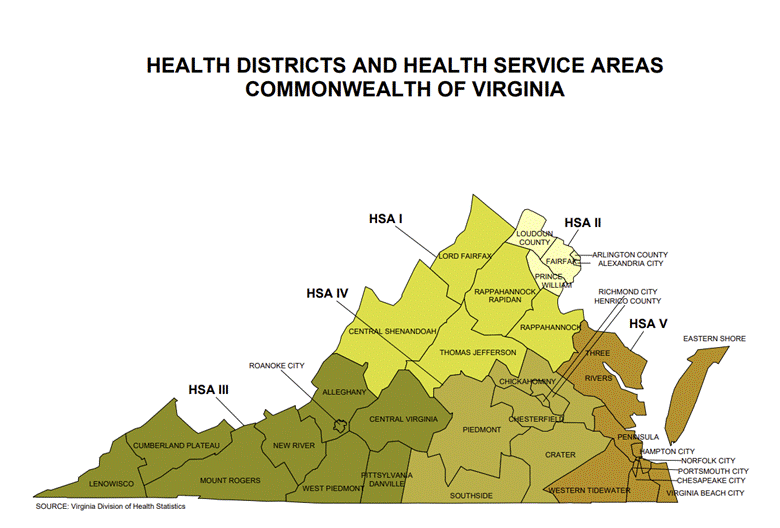
Image: Map of Health Districts and Health Service Areas in the Commonwealth of Virginia. Source: Virginia Board of Health and Virginia Division of Health Statistics
The Board of Pharmacy created emergency regulations for the safe and effective governing of medical cannabis pharmaceutical processors effective on August 7, 2017, and promulgated updates[75],[76] throughout their time as a governing body.
On January 1, 2024, oversight of the medical cannabis program shifted to the Cannabis Control Authority. Staff from the Board of Pharmacy and CCA worked closely and extensively together throughout the transition, and received counsel from the Office of the Attorney General related to change management. The CCA published draft regulations[77] related to medical cannabis on September 7, 2023, in which much of the terminology and language was adopted directly from the Board of Pharmacy regulations.
The Board of Pharmacy repealed their posted regulations[78] effective January 1, 2024, and CCA regulations became effective the same day[79]. The CCA updated pharmaceutical processor regulations in February 2025[80], with a focus on stricter marketing and labeling requirements, and additional regulations for the transport and delivery of medical cannabis. However, in October 2025, a Virginia circuit court ordered the CCA to void their amendments because they failed to hold appropriate public review and comment on the changes.
Each pharmaceutical processor may have up to six dispensary[81] locations, the first of which must be co-located with their cultivation and processing operation. Each dispensary location must have a Pharmacist in Charge on site responsible[82] for the oversight of medicinal cannabis dispersal to qualified patients, with licensed pharmacist technicians available to assist in this process. Allowable products for sale in the Commonwealth include tinctures, lotions, edibles, nasal sprays, suppositories[83], vape cartridges, and cannabis flower. New products must be tested and submitted to the governing entity for review and approval. No single dose[84] of a product can contain more than 10 milligrams of THC. Each product must be tested by a third-party lab and an analysis report must be provided before the product can be dispensed.
Original Applications
The application process for pharmaceutical processor permits has three stages: submission of initial application, award of conditional approval, followed by finalization of a pharmaceutical processor permit. Applications for licenses were first accepted by the Board of Pharmacy on April 16, 2018. The required information for each 2018 pharmaceutical processor application[85] included a detailed analysis of the applicant’s financial position and experience within the cannabis industry generally; disclosure of all owners and their written agreement to complete a criminal background check; narrative explanation of cannabis cultivation or other professional agricultural experience; the proposed locations of business, hours of operation, and anticipated commencement date; safety and security plans for inventory, personnel, and the premises; delivery plans that mitigate diversion risk; marketing plans; a compassionate need plan to support low income medical cannabis patients; a cannabis specific scientific research plan; and a confirmation that the applicant is allowed to conduct business within the Commonwealth. Additional forms provided by the Board and a $10,000 non-refundable fee was also required for an application to be considered complete.
The Board of Pharmacy received 51 complete applications by the June 8, 2018, 2 pm deadline. A closed committee reviewed and scored all applicants, and then submitted to the Board of Pharmacy recommendations for conditional license approval. Conditional licenses were awarded in the winter of 2018 to PharmaCann in HSA I, Dalitso in HSA II, Dharma Pharmaceuticals in HSA III, Green Leaf Medical in HSA IV, and Columbia Care in HSA V. After a multitude of mergers and acquisitions, some successful and others failed, along with a suite of related lawsuits and appeals, there have been significant changes of control in the majority of the health regions. Regulatory limits of one pharmaceutical processor per region still stands, although since 2020 each licensee may have up to five additional off-site medical cannabis dispensaries within their HSA.
Current Operators
HSA I was the final region to move forward with a successful pharmaceutical processor license award. despite multiple conditional licensees since the inaugural application process of 2018. AYR Wellness was granted their pharmaceutical processor permit on August 7th, 2026[86], and began retail sales in HSA I on August 19th, 2026. The HSA I conditional license was originally awarded to PharmaCann[87], who sold their conditional license to MedMen for $10 in December 2019, as part of a terminated business merger.
Ultimately, neither of the relevant parties in HSA I put forth effort towards the development of the pre-approved pharmaceutical processor property in the allotted one year timeframe, nor did they communicate effectively with the town council or with the Board of Pharmacy about this lack of development, which resulted in a revocation of the HSA I conditional license in June 2020. The Board of Pharmacy accepted new applications specific to HSA I in September 2020, with an anticipated[88] conditional approval by March of 2021, and 26 completed applications were received. However, related lawsuits from PharmaCann filed that same month in Henrico County paused the process for years. The Virginia Court of Appeals ruled in favor of the Board of Pharmacy in April 2023, finally allowing forward progress related to the 2020 application round. On July 6, 2023, the Board of Pharmacy issued a formal notification all HSA I active applicants that the Board may rescind the 2020 application, since oversight of the medical cannabis program will shift to the Cannabis Control Authority in January and the remaining calendar year would not provide enough time for a fair and complete evaluation of applications based on guidance from the Attorney General’s Office.
On September 26th 2023, three years after the initial request, the Board of Pharmacy voted unanimously to rescind the HSA I application[89], and encouraged all parties interested in a pharmaceutical processor license to engage with the CCA process in 2024, while refunding all 2020 applicant fees. On February 28th, 2024, the CCA released a Notice of Open Application for HSA I Pharmaceutical Processors[90], with all materials due by April 30th.
The CCA received 40 complete applications by the due date, and on September 5th, 2024, awarded a conditional license to AYR Wellness[91]. Some applicants that did not win sued the CCA, with claims that the licensing process was invalid,[92] though the lawsuit has since been dismissed by the Richmond Circuit Court. In July 2025, AYR narrowly avoided bankruptcy through a restructuring support agreement[93], and as of April 2026 was purchased by Arboretum Bidco LLC[94] with the financial support of Millstreet Capital Management via foreclosure sale. Arboretum will do business as AYR Wellness to develop a regulated medical cannabis presence in HSA I. The AYR Wellness cultivation and manufacturing facility is located in Winchester, and their second retail location[95] is in Staunton. The September launch of these two locations allows easier access to medical cannabis for patients in HSA I.
HSA II is controlled by Jushi Holdings, a publicly traded hemp and cannabis operator with more than 40 cannabis dispensaries across eight US states[96]. The international company gained majority control[97] of Virginia-based Dalitso in 2019, when Jushi paid $16 million to acquire 62% ownership of Dalitso. In December of 2020, Jushi purchased the last remaining stocks[98] of Dalitso for $22 million, resulting in Jushi’s 100% ownership control within the HSA II region. Also in December of 2020, the first medical dispensary in HSA II commenced operation[99] doing business as Beyond / Hello. The Beyond / Hello brand originated in Pennsylvania[100] before acquisition by Jushi in July 2019[101]. There are currently six licensed medical cannabis dispensaries[102] in HSA II.
Virginia-based Dharma Pharmaceuticals was the first licensee to commence retail operations in the Commonwealth, in HSA III, and opened their Bristol mall location[103] to registered patients on October 17th, 2020. Less than a year later, Dharma was forced to transition away from this location and instead to nearby Abingdon, when Hard Rock Hotel purchased the Bristol mall property to build a casino. Then, in May 2021 Green Thumb Industries announced an agreement[104] for 100% ownership acquisition of Dharma Pharmaceuticals for $80 million[105].
Green Thumb Industries is a national cannabis company that currently owns and operates 113 dispensary locations[106] under various names across 14 U.S. markets, plus a suite of seven cannabis brands, with all of their dispensaries operating under the “RISE” brand name. HSA III has six[107] RISE medical cannabis dispensaries, the most recent of which opened[108] on June 28th, 2023 in Danville, coincidentally down the street from our Cannabis Consultants Group headquarters at the time.
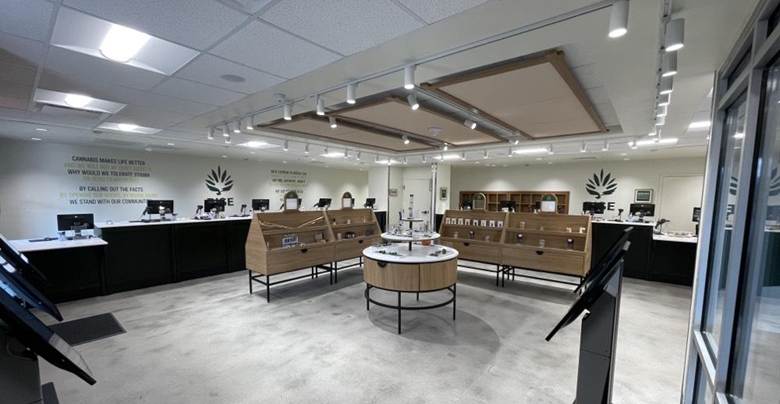
Image: Interior of RISE Danville Dispensary. Source: RISE Medical Marijuana Dispensary Danville August 2023.
Green Leaf Medical, commonly referred to as gLeaf, was awarded a conditional license in 2018 from the Board of Pharmacy to operate as a pharmaceutical processor in HSA IV, and received final operational approval on May 12, 2020[109]. Green Leaf Medical immediately commenced cultivation operations, quickly becoming the largest cultivator in the state, and opened their Richmond, Virginia location to medical cannabis patients in the late fall of 2020[110]. Mere months later, in December of 2020, Green Leaf agreed to be acquired[111] by Columbia Care for $240 million in cash and stocks; the transaction was completed[112] in June 2021.
The acquisition included the gLeaf operational vertically integrated facility in Richmond, their regional pharmaceutical processor license of Virginia, and their active licenses in the competitive cannabis markets of Maryland, Ohio, and Pennsylvania. As part of the merger agreement, the entire Green Leaf management team was retained, and the gLeaf CEO was instated as a voting member of the board. Additional dispensaries in HSA IV did not open until November 2021, with a location in Glen Allen owned by Columbia Care but branded as gLeaf. As of September 21, 2023, Columbia Care changed its legal operational name to The Cannabist Company[113],[114].
One additional dispensary location can still be added in HSA IV[115]. In February 2026, The Cannabist Company announced the sale of their Virginia operations[116] to an affiliate of Millstreet Capital Management; the daily operations of the company are intended to be run by Arboretum Virginia (doing business as AYR Virginia and AYR Wellness), the same company that acquired all HSA I assets.
The Cannabist Company was the original awardee of the HSA V conditional license in 2018[117] – known at the time as Columbia Care, with licensed dispensaries in Arizona, Massachusetts, New York, Illinois, Washington, D.C., California, Delaware, Puerto Rico, Pennsylvania, Maryland, and Florida. The first dispensary in HSA V was opened in December 2020[118] in the town of Portsmouth, and an additional five dispensary locations have since been added in the region, the most recent in Suffolk which opened on August 2nd, 2023.
For three years, The Cannabist Company held control of HSA IV and HSA V. This dual-region monopoly ended in the summer of 2024, when The Cannabist Company announced that all Arizona operations and HSA V based Virginia operations would be acquired by Verano Holdings[119]. The transaction was completed in August 2024 with consideration for the Virginia HSA V operations totaling $90 million[120],[121]. All six of the dispensaries in HSA V are now branded as Zen Leaf[122].
Future Applications
Applications for pharmaceutical processors in Virginia are not currently being accepted by any entity, and no upcoming application rounds are anticipated. There is a fully licensed pharmaceutical processor in each health service area, which is the maximum allowed by the law[123].
If the CCA opens applications for pharmaceutical processor licenses, the required information will likely include the name and address of the applicant and all owners; criminal background checks; expansive details of the applicant’s financial position including assets, liabilities, income, net worth, and as needed evidence of an escrow account, letters of credit, or performance surety bond; documents of proof that the applicant is permitted to do business in Virginia, such as State Corporation Commission registration or similar; disclosure of any previous medical cannabis application in any state, and the outcome therein, including any related disciplinary actions, as well as disclosure of any previous or current involvement in the medical cannabis industry.
Documentation of business practices and organizational intent will also likely be required, including an organizational chart; plans for the safe dispersal of medical cannabis; details of compassionate need programs that the business will offer; an odor mitigation plan; a waste management plan; and a multitude of additional operational plans.
Anticipated fees for pharmaceutical processors are $18,000 to apply and $165,000 for an initial permit, then an annual permit renewal fee of $132,000; location changes, remodels, acquisitions, or expansions are subject to a $5,000 fee. A separate application for each cannabis dispensing facility (up to five) or cultivation facility (one) permit shall be submitted to the board, with a predicted application fee of $5,000 and an initial permit fee of $80,000 per location. Additional fees apply for changes to the business name, changes of ownership, for each reinspection, and a $50 fee for the registration of each cannabis product with the CCA. All fees are non-refundable.
The application process for pharmaceutical processor permits will remain the same as previous application rounds, with three stages[124] including a submission of initial application, then an award of conditional approval, and a final issuance of a pharmaceutical processor permit after all inspections and other requirements are completed. A notice of open applications will be published by the CCA Board of Directors[125] and will include specific details on how to obtain and complete an application, the deadline, required fees, and criteria of scoring. Interestingly, the regulations do not provide details on how long the application window will be, nor if there will be any advance notice given. The CCA Board of Directors also reserves the right to change the notice of open applications at any point prior to the deadline for submitting an application.
Medical Cannabis Patients
After decades with no legal pathways to access medical cannabis – despite laws and strong agreement that cannabis is, in fact, medicine – there have now been more than 55,000 medical cannabis patients registered in Virginia[126], representing around 0.5% of the citizens. This is a significantly smaller percentage of registrants than in other medical-only cannabis states[127], with a national average around 2%. Medical cannabis patients in Virginia are no longer required to register with the Cannabis Control Authority to access products[128], so the number of citizens participating in the program could be significantly under-reported. The CCA estimates that 115,000 unique patients[129] purchased cannabis from a licensed dispensary in 2025.
All patients still have the option to receive a physical medical cannabis card and may register with the Cannabis Control Authority to receive one. Importantly, a physical card may be required by other states for reciprocity in their medical cannabis program. For example: Virginia dispensaries never provide medical cannabis to patients from outside the Commonwealth, but directly next door, the District of Columbia allows access to medical cannabis patients from many jurisdictions[130] with appropriate identification and documentation, including Virginia qualified patients without a registration card.
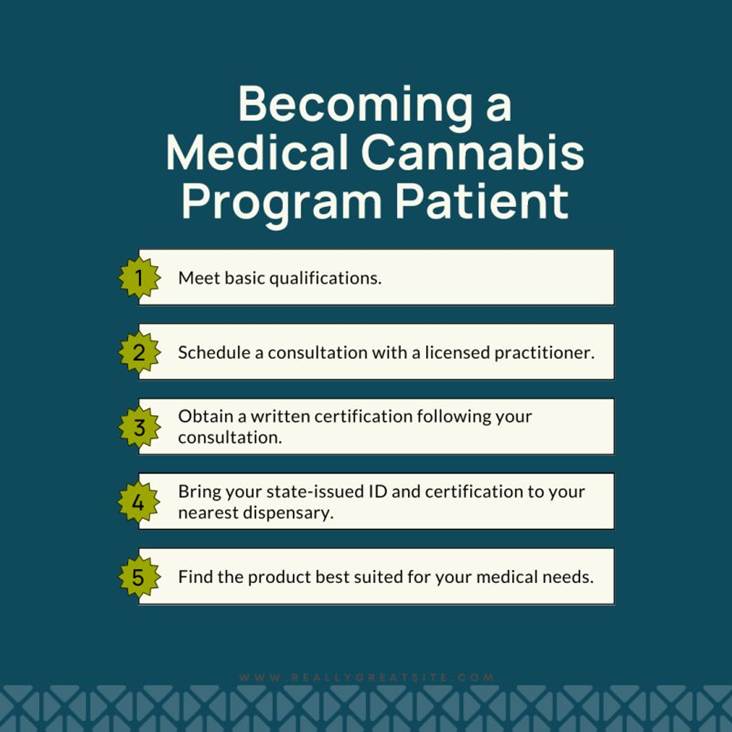
Image: Becoming a Medical Cannabis Program Patient. Source: Virginia Cannabis Control Authority
Citizens of the Commonwealth that wish to partake in the medical cannabis program could previously find a list of registered practitioners on the Board of Pharmacy website[131] to conduct a medical consultation. The certification process now overseen by the CCA allows any Practitioners of Medicine or Osteopathy, Physician Assistants, or Advanced Practice Registered Nurses actively licensed by the Board of Medicine to recommend cannabis products[132].
Recommendations for medical cannabis are notably different from prescriptions, as legal prescriptions must be on a specific DEA authorized prescription pad[133]. Medical cannabis oil can be administered to medical cannabis patients on school grounds and in hospice or assisted living facilities as needed. Unfortunately, many citizens of the Commonwealth remain unable to access the medical cannabis program due to exorbitant product prices.
Virginia Recreational Cannabis Licenses
Regulations
Originally passed in 2021, the Virginia Cannabis Control Act requires a legislative framework approved by the General Assembly prior to the CCA Board of Directors creation of any rules or regulations[134]. This was finally achieved through the 2026 budget bill, HB30, passed on June 29, 2026[135], which details certain aspects of the future marketplace and broadly defines requirements for the CCA. Responsibility is placed on the CCA to develop the regulatory framework for a safe and legal retail market and to clearly communicate expectations for the application process with all stakeholders.
The CCA released initial draft regulations on September 9, 2026[136]. The CPHAC will review the regulations and coordinate with the Board to establish impact licensee guidelines before the application period begins. New regulations in the Commonwealth usually undergo at least 30 days of public comment, [137], but the Board is statutorily exempted from that requirement for the initial regulations[138]. Local jurisdictions are likely to create additional ordinances specific to cannabis businesses such as limits to retail operational hours, however, localities are not allowed to prohibit cannabis business operations [139].
An individual may have a 10% interest in up to five licenses. Several combinations of license types are acceptable – such as five retail licenses, or three retail licenses with two cultivation licenses – however, only one application per license type is allowed per application round. Additionally, no person or entity can have more than 10% interest in more than one Tier V cultivation license, and microbusinesses or testing facilities licensees and interest holders may only have an interest in that one license. Material owners of 5% or more and interest holders of more than 10% will be subject to a background check.
All applicants, employees, and volunteers must be at least 21 years old. The Board may deny or revoke a license if an interest holder or owner has been convicted in any court of a felony or of any crime or offense involving moral turpitude. Any changes to a license must be pre-approved by the Board, including change of location, transfer of control, or sale of a license[140].
The 2026 budget bill broadly authorizes banks, credit unions, and CPAs to provide financial and accounting services for licensed cannabis businesses[141], and decouples Virginia from federal tax code regarding 280E. As of January 1, 2026 licensed cannabis operators can deduct ordinary and necessary business expenses at the state level[142] despite federal prohibition. Retail sales will have a state sales tax of 6% until July 1, 2029, at which point the rate will increase to 8%. This tax is not applicable for industrial hemp growers or processors, hemp products, pharmaceutical processors products, or on sales between licensed cannabis establishments. Retailers must collect taxes at the time of sale and remit payment to the CCA by the tenth of each month. Localities must adopt ordinances with an additional retail sales tax rate between 1-3.5% and their own payment processes.
All cannabis and cannabis products produced, distributed, or sold in the Commonwealth must be tested at a licensed and accredited laboratory. Testing of final products will include tests for residual solvents, heavy metals, microbiological contaminants, mycotoxins, pesticide chemical residue, and active ingredient analysis. Maximum THC limits for edible products are 10mg per serving, not to exceed 100mg per package, and the CCA may set additional limitations.
Each retail product label will identify the type of cannabis or cannabis product; unique serial number; net weight; THC, CBD, terpene, and cannabinoid content; all ingredients and any allergens; amount of servings per package; the total milligrams of THC and CBD; the total percentages of THC and CBD; instructions on usage; an expiration date; the date of testing and packaging; the CCA mandated child and other safety warning statements, and universal symbol; the cultivator or processor of origin; and a QR code linking to the certificate of analysis. Each unique product must be registered with the CCA[143] and detailed records for all sales are required. Although digital records are acceptable, all records must be capable of being reconstructed in the event of a computer malfunction or accident resulting in the destruction of a server or data bank.
Cannabis must be safely secured at all times. All cut parts of the plant must be kept in a vault or approved safe. Each vault and secure storage area must have restricted access and an alarm system with a failure notification system. A facility wide security system should include a duress alarm, fixed security cameras with extreme 9600 dpi resolution, and the ability to remain operational during a power outage.
All employees will receive training provided by the licensee on rules and regulations for the legal cultivation, processing, transportation, handling and sale of cannabis, the proper security measures, professional conduct, state and federal statutes and regulations regarding privacy and confidentiality, health and safety education related to cannabis use, and on procedures for age verification, seed-to-sale tracking, emergency response, and sanitation and safety. Each licensed cultivation and processing facility will have a registered responsible party with oversight of the cultivation and production areas who has at least two years of verifiable experience cultivating plants or extracting chemicals from plants.
Advertisements on licensed cannabis establishment property cannot display cannabis or use any imagery including the use of cannabis, cannot target anyone under the age of 21, cannot use any cartoons or mascots, no similarities to food, soda, or candy, and may only be designed to assist customers in identifying the licensed establishment, not to draw undue attention to the facility. Advertising restrictions in the Commonwealth further prohibit the use of billboards, and any outdoor signs on the same side of the road within 500 feet of a church, synagogue, mosque, other place of religious worship, a public, private, or parochial school, an institution of higher education, a public or private playground or recreational facility, a substance use disorder treatment center, or a residential dwelling.
Coupons or giveaways of free marijuana or regulated hemp products are not allowed on advertisements. Cannabis advertisements are not allowed at sporting events or in a public transit vehicle, public transit shelter, bus stop, taxi stand, transportation waiting area, train station, airport, or any similar transit related location.
Adult Use Market
Currently, adults in the Commonwealth are permitted to cultivate up to four secured cannabis plants per household for personal use, can gift or share up to one ounce with friends, and can possess (not consume[144]) up to two ounces in public. Public possession of more than two ounces of cannabis but less than four ounces may result in a civil penalty of $25, while an intent to distribute the same amount[145] is considered a felony.
When cultivating at home, each plant must be secured and have a tag on it with the owner’s name, driver’s license or id number, and a legible note that the plant is grown for personal use only[146]. There is no legal method in which to purchase a starter mother plant or seeds without a recreational retail market. Notable large-scale seed giveaways in the Commonwealth have taken place, including events from Veterans Initiative 22[147] and Virginia Marijuana Justice[148] on July 1st, 2021, when home cultivation first became legal, and multiple recurring and spontaneous events from Peninsula Hydroponics[149] (“pH”), a small locally-owned business.

Image: 2023 Black Friday Seed Giveaway Advertisement. Source: Peninsula Hydroponics Event Page.
Hemp derived THC dominated the Virginia recreational cannabis retail market for years, often sold in smoke shops or gas stations. These products do not conform to regulated testing or stringent marketing regulations, though some brands do perform independent product safety testing. To eradicate the unregulated businesses, the 2026 budget bill eliminated a 25:1 CBD:THC ratio rule that permitted retail hemp products to have significant amounts of THC. As of August 15, 2026, products can only have 2mg THC per package and all synthetic derivatives are strictly prohibited. Almost all retail hemp storefronts closed down immediately.
Retail sales of licensed cannabis for adult use will be available in the Commonwealth on July 1, 2027. Botanical flower, concentrates, vaporizers, and edible products will be available. Consumers can purchase two ounces of botanical cannabis, or eight grams of marijuana concentrate, or 800 milligrams of THC in edible products. Cannabis and related products will have a 6% state sales tax, plus local taxes. Regular retail purchases are permitted to sober adults over the age of 21 with valid government ID. Consumption of cannabis, cannabis products, or alcohol is strictly prohibited at licensed cannabis facilities and in public[150].
Recreational Cannabis Applications
The CCA will open retail marijuana applications for microbusinesses on or before February 1, 2027 and up to 100 licenses will be issued within three months. These licenses will be open to people that qualify as an impact licensee, an industrial hemp processor or grower, or a farmer under USDA qualifications, and will be awarded based on financial, security, and operational readiness criteria established by the CCA. At this time there will be an additional 10 cultivation and 10 processing licenses available exclusively to current or former industrial hemp growers and processors with a one-time fee of $500,000.
By July 1, 2027, 55 other licenses will also be awarded, which will be distributed across multiple license types at the discretion of the CCA. Adult-use cannabis license opportunities will continue to be announced. In many states advance notice is required from the regulating body prior to any cannabis application period to give interested parties enough time to understand what is needed. For example, neighboring Maryland is required to give 60 days’ advance notice[151]. However, the Virginia Board of Pharmacy notably accepted applications for pharmaceutical processors on the same day as their original request for application announcement, with all completed applications due 72 days later, and the CCA followed precedent but allowed even less time[152], issuing a notice of open application in early 2024 with all materials due 62 days later.
Some states have allowed currently licensed medical cannabis operators a transitional license to also serve the recreational retail market before a general application period is made available to the public. Original regulatory language from House Bill 2312 explicitly sought to avoid this, and instead described an initial application round with priority given to social equity applicants. The finalized 2026 budget bill requires each of the currently licensed pharmaceutical processors to register for adult retail dual-use or forfeit their license. Conversion applications for dual-use will be accepted in February 2027, with a $10 million registration fee payable over three years.
The application itself is likely to require ownership disclosures, business incorporation documentation, organizational structure information, and proof of financial responsibility through account documentation, tax history, letters of support, and financial projections. Any interest in other licenses, permits, registrants, or applicants, must be fully disclosed.
All license applicants and interest holders must be up to date with all taxes, at least 21 years old, and physically able to carry on the business. Each applicant must prove their knowledge and understanding related to the procedures, security controls, and accuracy of cannabis sales and tracking, and provide a plan to control against diversion, theft, and loss of cannabis.
Details about the proposed business location, security and safety plans, product testing plans, and inventory tracking plans will likely also be needed for the application. Proposed locations will need to be specifically identified for retailers and microbusinesses, although final control of the premises will not technically be required until the final stage of the license approval process[153]. All properties must be located in a way that will not adversely affect any residence or residential area, property values, place of religious worship, hospital, public, private, or parochial school or institution of higher education, public or private playground or other similar recreational facility, substance use disorder treatment facility, or federal, state, or local government-operated facility. Retail storefronts must be at least 1,000 feet away from any hospital, public, private, or parochial school or institution of higher education, or child day program.
All cannabis license applicants must have a labor peace agreement in place with a labor organization at the time of application, and maintain the agreement as a condition of licensure. Interestingly, any employee of the Department of State Police, or a sheriff or police office within the Commonwealth is prohibited from applying for a license and from holding 10% or more of any cannabis license; other elected or appointed officials may apply for a license so long as their official position is stated on the application.
A distinct license is required for each business location[154]. All licensed locations are required to meet stringent safety and security standards set by the CCA. If the CCA deems an application incomplete, there will be a ten-day window of opportunity for the applicant to supplement or correct the necessary information. Applicants that meet the initial qualification requirements set forth by the CCA will be entered into a lottery for preliminary licensure award, if there are more qualified applicants than the number of licenses available. Licensure will be granted for an interval of one year, with preliminary licenses awarded for 18 months. All cannabis and cannabis products must be tracked in detail from seed to the point of sale.
Impact licenses will be available to promote and encourage participation in the industry by people from historically economically disadvantaged communities. Impact license applicants will have waived or reduced application and license fees, access to grants or low interest business loan programs, a standardized preference in the licensing process, and will not be required to show proof of funds or current control of the proposed business property at the time of application. At least half of all licenses available per license type will be reserved for impact licensees.
Impact license applicants must maintain direct control of the marijuana establishment and at least 51% ownership. To qualify, a person must have resided for at least three of the past five years in a historically economically disadvantaged community, or between 1999 and 2025 have resided in a jurisdiction that was disproportionately policed for marijuana crimes according to the US Census Bureau.
In addition to the residency requirement, an impact applicant must meet at least one of six criteria: have been convicted of or adjudicated delinquent for the sale, gift, distribution, or possession of marijuana[155],[156]; be the parent, child, sibling, or spouse of a person who has been convicted of or adjudicated delinquent for the sale, gift, distribution, or possession of marijuana; attended for at least five years a public elementary or secondary school located in a historically economically disadvantaged community; received a Federal Pell Grant or attended for at least two years a college or university at which at least 30 percent of the students, on average, are eligible for a Federal Pell Grant; be a veteran of the Armed Forces of the United States; or have qualified for financial assistance or relief from the U.S. Department of Agriculture as a distressed farmer in the last five years. Businesses that are granted impact licenses may not sell or transfer a controlling interest in the license for at least five years.
License Types
The Virginia Cannabis Control Act originally defined license types of cultivation, manufacturing, retail, and wholesaler, and sets limits for each category. However, the 2026 budget bill updated the license types to cultivation, processing, testing, retail, dual use, transporter, delivery, and microbusiness, and limits the largest cultivators to only five licenses until January 1, 2028, and permanently limits the number of retail stores in the Commonwealth to 350.
The CCA may set additional license limits to ensure a competitive market, and the CCA will provide a report to the General Assembly every two years analyzing whether any limits should be placed on the number of licenses issued with the initial report due November 1, 2026. Although there is a distinct transporter license, all other license types are automatically granted the right to transport cannabis and related products between certain licensed facilities. On site consumption lounges and cannabis event sales are currently prohibited, but both concepts will be reviewed by the Joint Commission to Oversee the Transition of the Commonwealth into a Cannabis Retail Market with a report due by November 1, 2027. Licenses will be distributed systematically based on region and community, to avoid areas of oversaturation.
A cultivation license permits transport, cultivation, labelling, packaging, transfer, and sale of mature and immature cannabis and its seeds to and from other licensees. Cultivation licenses are divided across five tiers based on canopy space. Canopy includes areas between plants, pathways, walkways, and empty space between rows that allow for airflow, access, and other associated activities, and the square footage of each level of a stacked system is measured independently.
Rooms dedicated to processing, drying, curing, trimming, or mother plants, clones, and immature plants are not considered part of the canopy space. Immature plants can be up to 8 inches tall by 8 inches wide. Tier I licensees may cultivate up to 5,000 square feet; Tier II up to 10,000 square feet; Tier III up to 15,000 square feet; Tier IV up to 25,000 square feet; and the largest possible cultivation level is Tier V, permitted up to 35,000 square feet of canopy space. Tier I and Tier II licensees may cultivate indoor, outdoors, or both; all other tiers must grow indoor only, which includes greenhouses. The CCA may change the future square foot allowance per cultivation tier based on market demand, utilization rates, sales data, product transfers, inventory data, the volume of license applications and issuances, or the participation rates of impact licensees. Fees to apply for a cultivation license are $3,000 for Tier I and Tier II, $5,500 for Tier III, and $7,500 for Tier IV or Tier V facilities. If awarded a preliminary licensure, the initial authorization fee is $20,000 for Tier I, $25,000 for Tier II, $30,000 for Tier III, $35,000 for Tier IV, and $50,000 for Tier V, with annual renewal fees set at $5,000 less than the initial authorization.
A processing license permits transport, processing, labelling, packaging, transfer, and sale of mature cannabis and cannabis products to and from other licensees. Hydrocarbon-based solvent extraction and any other generally accepted technology are permitted for the safe and licensed extraction, production, and processing of cannabis. Currently accepted chemicals for solvent based extraction include ethanol, ethyl acetate, ethyl ether, heptane, hexane, pentane, 2-propanol (IPA), butane, and propane. Edibles and concentrates are allowed, and all products must be registered with the CCA. An application for a processing license will cost $5,000 with an initial authorization fee of $30,000 and an annual renewal fee of $25,000.
Testing licenses allow for the testing, research, development, and transport of cannabis and cannabis products from licensed cultivation, processing, and retailers, and from citizens cultivating at home. This testing license also allows for testing, research, and development of other substances. All testing laboratories must maintain ISO/IEC 17025 accreditation to secure a license. An individual with any interest in a testing laboratory license may not have an interest in any other cannabis license in the Commonwealth. Applications to the CCA for a testing facility license will cost $1,000 with an initial authorization and annual renewal fee of $2,000.
There will be a limit of 350 retail licenses in the Commonwealth. Retail licenses permit the sale of cannabis, cannabis products, immature plants, seeds, or paraphernalia, to legal consumers at a licensed retail store, in person delivery to legal consumers at their house or place of business, purchase and possession of cannabis, immature plants, seeds, or products, from a cultivator, processor, or transport licensee, transfer to delivery operators, and the ability to transport cannabis and related products to another licensed retailer. Sales via a drive-through window, curbside pickup, or vending machine are not allowed, and all sales or referrals from third party internet-based sales platforms are forbidden. Retail cannabis license applications will cost $4,000 with an initial authorization fee of $20,000 and an annual renewal fee of $15,000. Retail floor space can be up to 2,500 square feet.
Microbusinesses are vertically integrated licenses that permit cultivation, transfer, transport, processing, sale, and delivery of cannabis, cannabis products, immature plants, and seeds to other licensees and to legal retail consumers. Canopy limits are restricted to 5,000 square feet for indoor cultivation, or 10,000 square feet for outdoors. A microbusiness licensee may operate in two locations, for instance with cultivation and processing at one location with a retail location within 20 miles, with Board and locality approval. An individual with any interest in a microbusiness license may not have an interest in any other cannabis license in the Commonwealth. A microbusiness application will cost $1,000 with an initial authorization fee of $2,500 and annual renewal fee of $6,000.
Dual-use licensees must maintain all requirements of licensure as a pharmaceutical processor and may also sell cannabis and cannabis products to adult-use recreational consumers.
A transport license allows possession, transfer, and transport of cannabis, cannabis products, immature cannabis plants, and seeds, to or from a licensed cultivator, processors, retailer, microbusiness, testing facility, or other transporter. Transporter licenses do not count towards the five total licenses an individual may have an interest in. A transporter license application costs $500 with initial authorization fee of $2,500 and an annual renewal fee of $5,000.
A delivery license permits the licensee to take control of cannabis or cannabis products from a retail store or microbusiness and deliver the cannabis or cannabis products to legal consumers at their residence or business. No delivery is allowed to any school, hospital, child day care center, correctional facility, military base, marine terminal under the supervision of the Virginia Port Authority, or anywhere within the State Capitol. Deliveries must be in person with legal verification, and the use of drones is not permitted. Deliveries cannot be made at public gathering places such as sporting events, festivals, fairs, races, terminals of public transportation companies, or concerts. A delivery license application will be $500, with an initial license authorization fee of $2,500 and an annual renewal fee of $5,000.
Impact licensees and microbusinesses can enter into cooperative agreements, and may even lease space and cultivate, process, and sell cannabis on the premises of another licensee or at an industrial hemp processing facility. No more than one licensee can cultivate outdoors on a given parcel of land, and new outdoor cultivation licenses will not be approved on any property adjacent to an authorized outdoor cultivation even if they are a microbusiness or seeking a cooperative agreement. Any licensee can enter into wholesale distribution agreements with other licensees.
Conclusion
The political landscape for cannabis policy in the Commonwealth fundamentally shifted with the election of Governor Spanberger, and there will be a regulated adult-use retail market in 2027. The medical cannabis market finally has an HSA I provider, although costs are extremely high across the Commonwealth for medical cannabis products. Regulations will be finalized by December 2026, and a notice of application (or RFA, Request for Applications) may be available even sooner.
Cannabis Consultants Group will continue to track relevant bills, attend every CCA and Board of Directors meeting, and update this article to keep you prepared for the upcoming applications. Contact us for more information or to schedule a free consultation;
info@cannabisconsultants.group.
[1] VA Admin. Code § 18.2-251.1. Possession or distribution of marijuana for medical purposes permitted. https://law.lis.virginia.gov/vacode/title18.2/chapter7/section18.2-251.1/
[2] Report of the Joint Subcommittee, Commonwealth of Virginia. House Document #94. 1998. https://rga.lis.virginia.gov/Published/1998/HD94/PDF
[3] VA Senate Bill 1235. https://lis.virginia.gov/cgi-bin/legp604.exe?151+sum+SB1235
[4] VA House Bill 1445. https://lis.virginia.gov/cgi-bin/legp604.exe?ses=151&typ=bil&val=HB1445
[5] VA Senate Bill 1027. https://lis.virginia.gov/cgi-bin/legp604.exe?171+sum+SB1027&171+sum+SB1027
[6] VA House Bill 1251. https://lis.virginia.gov/cgi-bin/legp604.exe?181+sum+HB1251&181+sum+HB1251
[7] VA Senate Bill 1557. https://lis.virginia.gov/cgi-bin/legp604.exe?191+sum+SB1557
[8] VA Senate Bill 1406. https://lis.virginia.gov/cgi-bin/legp604.exe?211+sum+SB1406
[9] VA House Bill 2312. https://lis.virginia.gov/cgi-bin/legp604.exe?212+sum+HB2312
[10] Code of Virginia. Cannabis Control Act. 7 April 2021. https://legacylis.virginia.gov/000/chapter551.pdf
[11] VA Legislative Information System. SB 903. As Enacted with Governor’s Recommendation. 12 April 2023. https://legacylis.virginia.gov/cgi-bin/legp604.exe?231+sum+SB903
[12] VA Department of Agriculture and Consumer Services. Hemp Product Enforcement. 2023. https://www.vdacs.virginia.gov/food-hemp-product-enforcement.shtml
[13] VA Admin. Code § 3.2-4112. Virginia’s Industrial Hemp Law.
[14] Virginia Mercury. Hemp Retailers Start Seeing Big Fines as Virginia’s Tougher THC Law Takes Effect. August 1, 2023. https://www.virginiamercury.com/2023/08/01/hemp-retailers-start-seeing-big-fines-as-virginias-tougher-thc-law-takes-effect/
[15] U.S. Fourth Circuit Court of Appeals. Northern Virginia Hemp and Agriculture v. Commonwealth of Virginia. 7 January 2025.
[16] VA House Bill 698. https://legacylis.virginia.gov/cgi-bin/legp604.exe?241+sum+HB698
[17] VA Senate Bill 448. https://legacylis.virginia.gov/cgi-bin/legp604.exe?241+sum+SB448
[18] VA SB 448. Governor Youngkin Veto Statement. https://legacylis.virginia.gov/cgi-bin/legp604.exe?241+amd+SB448AG
[19] VA Senate Bill 970. https://lis.virginia.gov/bill-details/20251/SB970
[20] VA House Bill 2485. https://lis.virginia.gov/bill-details/20251/HB2485
[21] VA HB 2485 Governor Youngkin Veto Statement. 24 March 2025. https://lis.virginia.gov/bill-details/20251/HB2485/text/HB2485VG
[22] Virginia Department of Elections. 2017 General Elections, Results. https://web.archive.org/web/20171108034618/http://results.elections.virginia.gov/vaelections/2017%20November%20General/Site/Statewide.html
[23] Virginia Legislative Information System. HB 972/SB2. https://lis.virginia.gov/cgi-bin/legp604.exe?201+sum+SB2
[24] WSET news. GOP Gubernatorial Candidacy Event in Lynchburg. April 9, 2021.
[25] Virginia Business News. The Outside. December 31, 2021. https://www.virginiabusiness.com/article/the-outsider/
[26] Virginia Legislative Information System. 2022 Amendment. https://lis.virginia.gov/cgi-bin/legp604.exe?221+ful+SB591S4
[27] NORML. Virginia: Gov. Youngkin Moves to Re-criminalize Personal Possession of Marijuana. April 13, 2022. https://norml.org/blog/2022/04/13/virginia-gov-youngkin-moves-to-re-criminalize-personal-possession-of-marijuana
[28] The Daily Progress. June 2023. Youngkin Not Interested in Legalizing Recreational Marijuana Sales. https://dailyprogress.com/news/local/government-politics/youngkin-not-interested-in-legalizing-recreational-marijuana-sales/article_36dade90-1c1e-11ee-97e8-533b698ddf58.html
[29] Reports to the General Assembly (Virginia). 2022. https://rga.lis.virginia.gov/Published/2022/RD679
[30] Virginia Department of Agriculture and Consumer Services. Press Release: Amendments to Virginia’s Food and Drink and Industrial Hemp Laws Take Effect. June 15, 2023. https://www.vdacs.virginia.gov/press-releases-230615-hemp-product-enforcement.shtml
[31] CBS 6, WTVR. Virginia lawmakers work on marijuana retail market ahead of governor’s race. August 22, 2025. https://www.wtvr.com/news/local-news/virginia-lawmakers-marijuana-retail-market-aug-22-2025
[32] US Congress HB 1595. September 2019. https://www.congress.gov/bill/116th-congress/house-bill/1595
[33] US Congress HB 3884. December 2020. https://www.congress.gov/bill/116th-congress/house-bill/3884
[34] US Congress HB 3617. April 2022. https://www.congress.gov/bill/117th-congress/house-bill/3617
[35] VA House Bill 642. https://lis.virginia.gov/bill-details/20261/HB642
[36] VA Senate Bill 542. https://lis.virginia.gov/bill-details/20261/SB542
[37] NPR. The Virginia Republicans who voted in favor of a legal weed market. 20 February 2026. https://www.wvtf.org/news/2026-02-20/the-virginia-republicans-who-voted-in-favor-of-a-legal-weed-market
[38] VA House Bill 942. https://lis.virginia.gov/bill-details/20261/HB942
[39] VA Senate Bill 332. https://lis.virginia.gov/bill-details/20261/SB332
[40] VA House Bill 391. https://lis.virginia.gov/bill-details/20261/HB391
[41] VA Senate Bill 62. https://lis.virginia.gov/bill-details/20261/SB62
[42] VA SB 62 Governors Amendments . https://lis.virginia.gov/bill-details/20261/SB62/text/SB62G
[43] Proposed Governor Substitute of HB 642. 13 April 2026. https://lis.virginia.gov/bill-details/20261/HB642/text/HB642H4
[44] WTVR News CBS 6. Gov. Spanberger’s changes to Virginia’s retail marijuana rollout sparks pushback. 20 April 2026. https://youtu.be/PNtqh1CSpPY?si=9AkZRrVFti_stbMM
[45] Virginia Public Media. Virginia lawmakers push back on Spanberger’s changes to retail weed market bill. 17 April 2026. https://www.vpm.org/generalassembly/2026-04-17/abigail-spanberger-cannabis-retail-market-weed-bill-aird-krizek-higgs-wise
[46] WFIR News. Virginia Lawmakers Push Back on Governor Spanberger’s Cannabis Amendments. 15 April 2026. https://wfirnews.com/news/virginia-lawmakers-push-back-on-gov-spanbergers-cannabis-amendments#:~:text=Spanberger’s%20cannabis%20amendments.%20Virginia%20lawmakers%20are%20pushing,same%20penalties%20the%20state%20eliminated%20years%20ago.
[47] VA Senate Votes SB542 Substitution. 22 April 2026. https://lis.virginia.gov/vote-details/SB542/20261/SV1526
[48] Office of The Governor. Governor Spanberger Issues Vetoes. 19 May 2026. https://www.governor.virginia.gov/newsroom/news-releases/2026/may-releases/name-1118109-en.html
[49] HB 642 Governor Veto Statement. 19 May 2026. https://lis.virginia.gov/bill-details/20261/HB642/text/HB642VG
[50] WVTF Virginia Public Radio. Senator labels Spanberger a ‘false hope’ after legal marijuana retail market veto. 19 May 2026. https://www.wvtf.org/news/2026-05-19/senator-labels-spanberger-a-false-hope-after-legal-marijuana-retail-market-veto
[51] Tevin Davis YouTube. Exclusive FaceTime with VA Governor Abigail Spanberger. 25 May 2026. https://youtu.be/eS1i5E5XWnI
[52] X. Virginia Delegate Rozia A. Henson Jr. Statement on Governor Vetoes. 20 May 2026. https://x.com/Henson4Virginia/status/2057088832084783138
[53] WTKR News. Watch Full: Governor Spanberger announces compromise to legalize retail marijuana in Virginia. 16 June 2026. https://youtu.be/9XS6pMKM_5U
[54] Richmond Times-Dispatch. Spanberger: Reviving vetoed bills in a budget would be an ‘abuse of the process’. 28 May 2026. https://richmond.com/news/state-regional/government-politics/article_f45e215d-4624-44bd-8216-22066d9183e7.html
[55] Office of the Governor. Governor Spanberger Celebrates Record Education, Healthcare, & Housing Investments in Final Budget. 29 June 2026. https://www.governor.virginia.gov/newsroom/news-releases/2026/june-releases/name-1120418-en.html
[56] Virginia LIS. HB30 – 2026 Special Session. Budget Bill. 29 June 2026. https://lis.virginia.gov/bill-details/20262/HB30
[57] VA Register of Regulations. 18 VAC § 110-60, Regulations Governing Pharmaceutical Processors. 7 August 2017. https://register.dls.virginia.gov/details.aspx?id=6508
[58] VA § 54.1-3305. Board; membership; terms; meetings; quorum; officers.
[59] VA CCA. Public Health and Public Safety Resources. https://cca.virginia.gov/resources
[60] VA CCA. Meeting Calendar. https://cca.virginia.gov/bod#previous
[61] WMAL Virginia News. Press Release: Governor Youngkin Announces Key Administration Appointments. August 2022. https://www.wmal.com/2022/08/02/press-release-governor-youngkin-announces-key-administration-appointments/
[62] Governor Northam. Press Release: Governor Northam Announces Appointments to Three Cannabis Oversight Boards.19 July 2021. https://www.governor.virginia.gov/newsroom/all-releases/2021/july/headline-898865-en.html
[63] VA CCA. Board Meeting Minutes. 20 July 2023. https://cca.virginia.gov/sites/default/files/Agenda_Minutes/BoDJuly202023MeetingMinutesDRAFT.pdf
[64] Office of the Governor. Governor Spanberger Announces Board Appointments. 26 June 2026. https://www.governor.virginia.gov/newsroom/news-releases/2026/june-releases/name-1120345-en.html
[65] VA CCA. Leadership Team. https://cca.virginia.gov/about
[66] VA CCA. Organizational Structure Draft. Senate of Virginia: Joint Commission to oversee Commonwealth transition Public Meeting. 17 August 2026.
[67] VA Admin. Code § 4.1-603. Cannabis Public Health Advisory Council.
[68] VA Secretary of Health and Human Services. About Us. January 2023. https://www.hhr.virginia.gov/about-us/
[69] VA General Assembly Studies – Cannabis Equity Reinvestment Board. https://studies.virginiageneralassembly.gov/studies/560
[70] VA Admin. Code § 2.2-2499.5. Cannabis Equity Reinvestment Board; purpose; membership; quorum; meetings.
[71] VA Senate Bill 1027. https://lis.virginia.gov/cgi-bin/legp604.exe?171+sum+SB1027&171+sum+SB1027
[72] VA Admin. Code § 54.1-3442.6. Permit to operate a pharmaceutical processor or cannabis dispensing facility.
[73] VA Admin. Code § 54.1-3408.3. Definitions: Pharmaceutical Processor.
[74] VA Health Systems Agency. Health Planning Regions and Districts Map. https://hsanv.org/healthdistrictsva.html
[75] VA Register of Regulations. Vol 37, Iss 21, Pg 101. August 2020. Regulations Governing Pharmaceutical Processors. https://register.dls.virginia.gov/vol37/iss01/v37i01.pdf
[76] VA Register of Regulations. Vol 39, Iss 24, Pg 96. July 2023. Regulations Governing Pharmaceutical Processors. https://register.dls.virginia.gov/vol39/iss24/v39i24.pdf
[77] VA CCA. Draft Regulations. 7 September 2023. https://cca.virginia.gov/sites/default/files/RegulationsDraft.pdf
[78] VA Board of Pharmacy Meeting. Update on Transfer of Medical Cannabis Program to CCA. 23 May 2023. https://townhall.virginia.gov/l/GetFile.cfm?File=meeting\30\37173\Agenda_DHP_37173_v3.pdf
[79] VA Register of Regulations. Vol 40, Iss 11. PG 960-991. https://register.dls.virginia.gov/vol40/iss11/v40i11.pdf
[80] VA Admin. Code. Virginia Cannabis Control Authority; Medical Cannabis Program Fees; Applications, Licenses, Permits, and Registrations; Regulated Operations; Cannabis Products; Testing of Cannabis Products; Labeling and Packaging; Enforcement. https://law.lis.virginia.gov/admincode/title3/agency10/chapter20/
[81] VA Admin. Code § 4.1-1602(J). Permit to operate pharmaceutical processor or cannabis dispensing facility.
[82] VA Admin. Code § 3.10-40-130. PIC Responsibilities.
[83] VA Board of Pharmacy Newsletter. April 2021. https://www.dhp.virginia.gov/pharmacy/newsletters/2021/VA04162021.pdf
[84] VA Admin. Code § 4.1-1602(C)(ix). Regulations establishing health, safety, and security requirements for pharmaceutical processors and cannabis dispensing facilities.
[85] VA Board of Pharmacy. Pharmaceutical Processor Request for Application. 16 April 2018.
[86] WMRA Radio. Area’s first medical cannabis dispensary opens in Winchester. 19 August 2026. https://www.wmra.org/2026-08-19/areas-first-medical-cannabis-dispensary-opens-in-winchester
[87] VA Board of Pharmacy. Minutes of Board of Pharmacy Meeting. 28 November 2018.
[88] VA Department of Health Professions. Pharmaceutical Processor Request for Application. 25 September 2020. https://www.dhp.virginia.gov/pharmacy/PharmaceuticalProcessing/docs/RFA_PharmaceuticalProcessors2020.pdf
[89] VA Board of Pharmacy Meeting Minutes. 26 September 2023. https://townhall.virginia.gov/l/GetFile.cfm?File=meeting\30\37183\Minutes_DHP_37183_v1.pdf
[90] CCA Notice of Open Application – HSA I Pharmaceutical Processor. https://virginiacca.sharepoint.com/sites/CCA-Website-Files/Shared%20Documents/NOAs/HSA1/Notice-of-Application-for-HSA1.pdf?ga=1
[91] CCA News Release. CCA Grants Conditional Approval to AYR Virginia. 5 September 2024. https://cca.virginia.gov/news/cca-grants-conditional-approval-to-ayr-virginia
[92] Virginia Business. Virginia Marijuana Permit Lawsuit. 6 May 2025. https://virginiabusiness.com/virginia-marijuana-permit-lawsuit/
[93] AYR Wellness Press Release. AYR Wellness Enters Into Restructuring Support Agreement with Senior Noteholders. 30 July 2025. https://ir.ayrwellness.com/news-events/press-releases/detail/264/ayr-wellness-enters-into-restructuring-support-agreement
[94] AYR Wellness Press Release. AYR Wellness Announces Closing of Exit Facility and Related Transactions. 10 April 2026. https://ir.ayrwellness.com/news-events/press-releases/detail/273/ayr-wellness-announces-closing-of-exit-facility-and-related
[95] AYR Wellness. Dispensary Locations. https://ayrdispensaries.com/stores/ayr-staunton/info
[96] Jushi. Meet Our Retail Stores. https://jushico.com/retail/
[97] Jushi. Press Release: Jushi Holdings Inc. Continues Expansion in the Northeastern U.S. by Entering into Acquisition of Virginia-Based Pharmaceutical Processor for Medical Cannabis Extracts. July 2019. https://ir.jushico.com/news-events/press-releases/detail/13/jushi-holdings-inc-continues-expansion-in-the-northeastern
[98] Jushi. Press Release: Jushi Holdings Inc. Acquires Remaining Equity Ownership Interests of Dalitso LLC, the Company’s Virginia-Based Pharmaceutical Processor Permit Holder. December 2020. https://ir.jushico.com/news-events/press-releases/detail/111/jushi-holdings-inc-acquires-remaining-equity-ownership
[99] Inside Northern Virginia. NoVA first medical marijuana dispensary opens in Manassas. December 2020. https://www.insidenova.com/headlines/northern-virginias-first-medical-marijuana-dispensary-opens-in-manassas/article_dce2718e-33f7-11eb-bad1-0724f7cfad61.html
[100] Beyond Hello. About Us. https://beyond-hello.com/about-us/
[101] Bloomberg. Jushi Holdings Inc. Announces Closing Of Deal To Acquire 100% Interest In Pennsylvania Medical Marijuana Dispensary Operators. https://www.bloomberg.com/press-releases/2019-07-11/jushi-holdings-inc-announces-closing-of-deal-to-acquire-100-interest-in-pennsylvania-medical-marijuana-dispensary-operators
[102] Beyond Hello. Virginia Dispensaries. https://beyond-hello.com/virginia-dispensaries/
[103] Virginia NORML. First Virginia Medical Cannabis Dispensary Grand Opening. October 2020. https://www.vanorml.org/2020-10-15-first-virginia-medical-cannabis-dispensary-grand-opening
[104] Securities and Exchange Commission. Green Thumb Industries Quarterly Report. May 2021. https://www.sec.gov/Archives/edgar/data/1795139/000119312521159019/d506090dex991.htm
[105] NASDAQ. Marijuana Investing. September 2021. https://www.nasdaq.com/articles/marijuana-investing:-the-pros-and-cons-of-msos-2021-09-22
[106] Green Thumb Industries. https://www.gtigrows.com/
[107] VA Cannabis Control Authority. Medical Cannabis Dispensary Locations. https://cca.virginia.gov/medicalcannabis/dispensaries#hsa3
[108] VA News – WDBJ 7. RISE to open as first medical marijuana dispensary in Danville. June 2023. https://www.wdbj7.com/2023/06/22/rise-open-first-medical-marijuana-dispensary-danville/
[109] VA Board of Pharmacy. BOP Newsletter – Third Pharmaceutical Processor Permit Issued. July 2020. https://www.dhp.virginia.gov/pharmacy/newsletters/2020/VA07012020.pdf
[110] Forbes. Second Medical Dispensary, Green Leaf Medical, Opens. November 2020. https://www.forbes.com/sites/nikkifrias/2020/11/29/second-medical-dispensary-green-leaf-medical-of-virginia-opens-in-richmond-virginia/?sh=1edca9d25232
[111] Cannabis Business Times. Columbia Care Signs Definitive Agreement to Acquire Green Leaf Medical. December 2020. https://www.cannabisbusinesstimes.com/news/columbia-care-to-acquire-green-leaf-medical/
[112] Businesswire. Columbia Care Completes Acquisition of Green Leaf Medical; Cements Market Leading Position in Mid-Atlantic. June 2021. https://www.businesswire.com/news/home/20210611005241/en/Columbia-Care-Completes-Acquisition-of-Green-Leaf-Medical-Cements-Market-Leading-Position-in-Mid-Atlantic
[113] Businesswire. Columbia Care Unveils New Name and Brand Identity – The Cannabist Company – to Bring Passion and People to the Forefront. 19 September 2023. https://www.businesswire.com/news/home/20230919366096/en/Columbia-Care-Unveils-New-Name-and-Brand-Identity-%E2%80%93-The-Cannabist-Company-%E2%80%93-to-Bring-Passion-and-People-to-the-Forefront
[114] Businesswire. Columbia Care to Rebrand as Cannabist. September 2021. https://www.businesswire.com/news/home/20210902005832/en/Columbia-Care-to-Rebrand-as-Cannabist-in-Florida
[115] VA Department of Health Professions. Medical Cannabis Dispensary Locations by Health Service Area. https://www.dhp.virginia.gov/pharmacy/PharmaceuticalProcessing/docs/DispensingLocations.pdf
[116] The Cannabist Company Press Release. The Cannabist Company Announces Closing of Transaction for the Sale of Virginia Assets to an Affiliate of Millstreet. 5 February 2026. https://investors.cannabistcompany.com/news-releases/news-release-details/cannabist-company-announces-closing-transaction-sale-virginia#:~:text=The%20Cannabist%20Company%20Announces%20Closing,CHELMSFORD%2C%20Mass.
[117] Columbia Care. Press Release: Columbia Care Selected by the Virginia Board of Pharmacy as One of Five Licensees to Produce and Dispense Cannabinoid-Based Medicines in Virginia. October 2018. https://ir.col-care.com/press-releases/press-release-details/columbia-care-selected-virginia-board-pharmacy-one-five
[118] Businesswire. Columbia Care Opens its First Dispensary in Virginia. December 2020. https://www.businesswire.com/news/home/20201229005432/en/Columbia-Care-Opens-its-First-Dispensary-in-Virginia
[119] The Cannabist Company. Press Release. Verano Enters into Agreements with The Cannabist Company to Acquire One of Its Virginia Licenses and Associated Operations and Its Arizona Operations. 29 July 2024. https://investors.cannabistcompany.com/news-releases/news-release-details/verano-enters-agreements-cannabist-company-acquire-one-its
[120] The Cannabist Company. Press Release. Verano Announces Closing of Acquisition of Arizona and Virginia Subsidiaries of The Cannabist Company, Becomes Exclusive Cannabis Operator for HSA 5 in Eastern Virginia and Strengthens Arizona Footprint. 22 August 2024. https://investors.cannabistcompany.com/news-releases/news-release-details/verano-announces-closing-acquisition-arizona-and-virginia#:~:text=%E2%80%9COur%20entrance%20into%20Virginia%20provides,Chairman%20and%20Chief%20Executive%20Officer.
[121] Verano Holdings. Press Release. Verano Announces Closing of Acquisition of Arizona and Virginia Subsidiaries of The Cannabist Company, Becomes Exclusive Cannabis Operator for HSA 5 in Eastern Virginia and Strengthens Arizona Footprint. 22 August 2024. https://investors.verano.com/news-releases/news-release-details/verano-announces-closing-acquisition-arizona-and-virginia#:~:text=Acquisitions%20Expand%20Verano’s%20Footprint%20to,NEWSWIRE)%20%2D%2D%20Verano%20Holdings%20Corp.
[122] Virginia Cannabis Control Authority. Medical Cannabis Dispensary Locations. https://cca.virginia.gov/medicalcannabis/dispensaries#hsa5
[123] VAC § 4.1-1602(B). Permit to operate pharmaceutical processor or cannabis dispensing facility.
[124] VAC 3 § 10-30-210(A). Application process for pharmaceutical processor permits.
[125] VAC 3 § 10-30-100(A-C). Publication of notice for submission of applications.
[126] VA Board of Pharmacy. Medical Cannabis Program Report. Q2 2023.
[127] Marijuana Policy Project. Medical Cannabis Patient Numbers. https://www.mpp.org/issues/medical-marijuana/state-by-state-medical-marijuana-laws/medical-marijuana-patient-numbers/
[128] Virginia’s Legislative Information System. House Bill 933. April 2022. https://lis.virginia.gov/cgi-bin/legp604.exe?221+sum+HB933
[129] VA CCA. 2025 Annual Report. 1 July 2025. https://virginiacca.sharepoint.com/sites/CCA-Website-Files/Shared%20Documents/Reports/2025-CCA-Annual-Report.pdf?
[130] DC Alcoholic Beverage and Cannabis Administration. Patients – Non-DC Residents. https://abca.dc.gov/page/patients-non-dc-residents#gsc.tab=0
[131] Board of Pharmacy. List of Registered Practitioners for Medical Cannabis. https://www.dhp.virginia.gov/pharmacy/PharmaceuticalProcessing/RegisteredPractitionerList.asp#top
[132] VA CCA. Medical Cannabis Practitioners. https://cca.virginia.gov/medicalcannabis/providers
[133] National Library of Medicine. Pharmacy Prescription Requirements. September 2022. https://www.ncbi.nlm.nih.gov/books/NBK538424/
[134] VA House Bill 2312. https://lis.virginia.gov/cgi-bin/legp604.exe?212+sum+HB2312
[135] VA HB 30. 29 June 2026. https://lis.virginia.gov/bill-details/20262/HB30
[136] VA CCA. Retail Marijuana Market Timeline. https://cca.virginia.gov/retailmarijuanamarket
[137] VA Admin. Code § 2.2-4007.01(A)(ii). Notice of intended regulatory action; public hearing. 2007. https://law.lis.virginia.gov/vacode/title2.2/chapter40/section2.2-4007.01/
[138] VA HB 30. Enactment Clause 20. 29 June 2026.
[139] VA Admin. Code § 4.1-629(A). Local ordinances or resolutions regulating marijuana or marijuana products.
[140] VA Admin. Code § 4.1-606(B)(20). Regulations of the Board.
[141] VA Admin. Code § 6.2-108. Financial services for licensed marijuana establishments; § 54.1-4426. Accounting services for licensed marijuana establishments.
[142] VA Admin. Code § 58.1-301(B)(12). Conformity to Internal Revenue Code.
[143] VA Admin. Code § 4.1-1407. Product registration requirements; approval, deviation, and modification.
[144] VA Admin. Code § 4.1-1108. Consuming marijuana or marijuana products, or offering to another, in public place; penalty. 2021. https://law.lis.virginia.gov/vacode/title4.1/chapter11/section4.1-1108/
[145] VA Admin. Code § 18.2-248.1(a)(2).
[146] VA Admin. Code § 4.1-1101. Home cultivation of marijuana for personal use; penalties. 2026. https://law.lis.virginia.gov/vacode/title4.1/chapter11/section4.1-1101/
[147] Veterans Initiative 22. Homepage. https://www.veteransinitiative22.com/
[148] Virginia Marijuana Justice. Press Release: VAMJ Marks July 1 Legalization with Free Seed Giveaway. June 2021. https://vamj.org/virginia-marijuana-justice-marks-july-1-legalization-with-free-seed-giveaway/
[149] Peninsula Hydro. Events and Classes. https://www.peninsulahydroponics.com/events
[150] VA Admin. Code § 4.1-1108. Consuming marijuana or marijuana products, or offering to another, in public place; penalty.
[151] COMAR § 14.17.05.03(A). Application Process and Issuance of Licenses.
[152] VA CCA. Notice of Open Application for HSA I. 28 February 2024. https://cca.virginia.gov/noa/hsa1
[153] VA Admin. Codes § 4.1-810(B)(3)(i). Subdivision 3 final note.
[154] VA Admin. Code § 4.1-702(A).
[155] VA Admin. Code § 18.2-248.1.
[156] VA Admin. Code § 18.2-265.3(A).